The Dynamics Of Marine Craft: Maneuvering And Seakeeping

Wave exciting forces are induced by the direct action of the incident waves on the body. In linear theory, these forces are directly proportional to the wave amplitude, which is assumed to be small. The leading-order interactions between the exciting forces and the radiation forces, which are proportional to the small body motions, are thus expected to be of the order of the product of the wave and body motion amplitudes. These interactions can therefore be neglected in linear theory, so that the body can be assumed to be fixed in its equilibrium position for evaluation of the exciting forces.
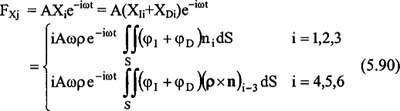
Making use of Eq. (5.12) and the superposition principle, we can write the exciting force in the form

where
and A is the wave amplitude. The potentials ? I and ? D represent the effects of the incident and diffracted waves, respectively, and are functions of location as well as the wave heading and frequency. Because of the assumption that the body is fixed, the body boundary condition is just
or
on the body surface. Note that the incident wave potential ? I is known (see Eq. (4.20)); thus
Since this "diffraction problem" differs from the previously considered radiation problem only in the right-hand side of the body boundary condition, we can use the same procedures to obtain the diffraction potential as those we used to obtain the radiation potentials. In particular, if the body is...