Geometric Linear Algebra, Volume 1

Chapter 2: The Two-Dimensional Real Vector Space R2

Introduction

In our physical world, one can realize that there does exist a point, lying outside of a given straight line.

In Fig. 2.1, the point Q does not lie on the line L. This point Q and the moving point X on the line L generate infinitely many straight lines QX. We image that the collection of all such lines QX constitute a plane.


Figure 2.1

Therefore, we formulate the

Postulate Three noncollinear different points determine a unique plane.

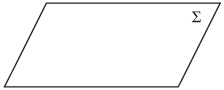
The face of a table or a piece of horizontally placed paper, imagined extended beyond limit in all directions, all can be considered as a geometric model of a plane. Usually, a parallelogram, including its interior, will act as a symbolic graph of a plane ? (see Fig. 2.2).


Figure 2.2

About plane, one should know the following basic facts.

  1. A plane ? contains uncountably many points.

  2. The straight line, determined by any pair of different points in a plane ?, lies in ? itself. Therefore, starting from a point and then a line on which the point does not lie, one can construct a plane.

  3. The plane, generated by any three points in a plane ?, coincides with ?.

  4. (Euclidean parallelism axiom) Let the point P and the line L be in the same plane ?, with P lying outside of L. Then, there exists one and only one line...

UNLIMITED FREE
ACCESS
TO THE WORLD'S BEST IDEAS

SUBMIT
Already a GlobalSpec user? Log in.

This is embarrasing...

An error occurred while processing the form. Please try again in a few minutes.

Customize Your GlobalSpec Experience

Category: Form Gages and Form Gaging Systems
Finish!
Privacy Policy

This is embarrasing...

An error occurred while processing the form. Please try again in a few minutes.