Geometric Linear Algebra, Volume 1

In our real world, there does exist a point lying outside a fixed given plane. For example, a lamp (considered as a point) hanging over a desk (considered as a plane) is such a case.
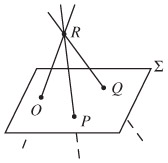
Figure 3.1 shows that one point R is not on the plane ?. The family of the straight lines connecting R to all arbitrary points in ? are considered, in imagination, to form a so-called three-dimensional space, physically inhabited by the human being.
Therefore, we have the
Postulate Four different non-coplanar points determine a unique (three-dimensional) space.
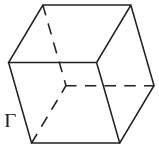
Here and only in this chapter, the term "space" will always mean three-dimensional as postulated above. Usually, a parallelepiped including its interior is considered as a symbolic graph of a space ? (see Fig. 3.2).
One should be familiar with the following basic facts about space ?.
? contains uncountably many points.
? contains the line generated by any two different points in it, the plane generated by any three non-collinear points in it, and coincides with the space determined by any four different non-coplanar points in it.
A space ? possesses the following Euclidean geometric concepts or quantities.
Length.
Angle.
The area of a rectangle is equal to length times width, and therefore, the area of a parallelogram is equal to height times base (length).
The volume of a rectangular box is equal to length times width times height, and therefore, the...