Hypermodels In Mathematical Finance: Modelling Via Infinitesimal Analysis
7.6: Solving Stochastic Differential Equations

7.6 Solving Stochastic Differential Equations

We briefly mention some results on solving stochastic differential equations.

One type of existence result for stochastic differential equations is the following.

Theorem 7.19

Let b be the n-dimensional Anderson s Brownian motion with filtration {F t } t ?[0,1]. Let

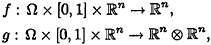
be bounded and measurable. Suppose that the determinant of g is uniformly bounded away from 0, i. e. for some ,

Then for any F 0 -measurable x 0, there is a continuous adapted process x satisfying

Another type is some thing like this:

Theorem 7.20

(Still using the same n-dimensional b and the same filtration.) Let

such that f( ?, s, ), g( ?, s, ) are bounded adapted processes with values in the space of continuous functions and respectively. Then for any F 0 -measurable x 0, there is a continuous adapted process x satisfying

It should be noted that the above gives strong solutions in the sense that the same filtration works for any f, g in the theorem. This is a feature of Anderson s Brownian motion that distinguish it from standard Brownian motion and filtrations. Very often, standard results produce only weak solutions, i.e. the choice of filtration depends on the particular f and g.

For complete proofs and discussions, as well as generalizations, see [Albeverio et al., 1986], [Keisler, 1984], [Lindstr m, 1980] and [Stroyan and Bayod, 1986]. See also [Hoover and Perkins, 1983] for dealing with equations...

UNLIMITED FREE
ACCESS
TO THE WORLD'S BEST IDEAS

SUBMIT
Already a GlobalSpec user? Log in.

This is embarrasing...

An error occurred while processing the form. Please try again in a few minutes.

Customize Your GlobalSpec Experience

Category: Accelerometers
Finish!
Privacy Policy

This is embarrasing...

An error occurred while processing the form. Please try again in a few minutes.