Ionizing Radiation Detectors For Medical Imaging

Positron Emission Tomography (PET) is a powerful and sensitive technique for functional imaging in the Field of Nuclear Medicine. The principle of operation is different from most other transmission technologies. These tend to be based on the detection of a beam of radiation transmitted through the patient: the image represents the three-dimensional (3D) attenuation properties of biological tissues and gives density and morphology information.
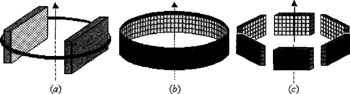
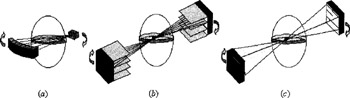
Conversely in PET, a positron emitting radiopharmaceutical is injected into the patient and spreads physiologically within the body: the activity distribution will be proportional to the drug concentration. The emitted positrons annihilate with electrons in the tissue producing two back-to-back 511 keV photons. These are measured in electronic coincidence by using opposing pairs of detectors, which are mounted on a rotating gantry or in a stationary configuration, as either a circular or a polygonal ring (Fig. 8.1). This gives thus an intrinsically tomographic imaging (Fig. 8.2). The positron emission is isotropic: there is no bias in the emission directions. The electronic coincidence detection intrinsically implies alignment, so anti-scattering and passive collimators are not needed and a higher detection efficiency is achieved.