3.3 Applications of Weighted Residual Methods
Weighted residual methods [1] are a general class of approximate solution methods characterized by a distribution of solution error over the global problem domain through the use of an integrated, weak form ( c.f., Section 3.2) of the original differential equation. The approximate methods of Section 3.2.3 are included in the general weighted residual method. This section will demonstrate applications of the weighted residual method using a variety of methods on several example problems.
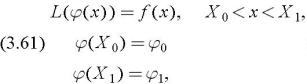
To begin, consider the one-dimensional differential equation and boundary conditions
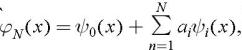
where L is a differential operator, ?( x) is an unknown function (the desired solution), f ( x) is a given function, and ? 0 and ? 1 are constants. Suppose a variable  , is an approximate solution having the form
with N a given integer, ? 0( x) a function satisfying the boundary conditions, a i are (unknown) constant coefficients and ? i ( x) are known functions. These functions, called basis functions, satisfy homogeneous boundary conditions. The function  will not, in general, satisfy the differential equation. Therefore, a residual function is defined as
such that r ( ?) = L ( ?) ? f ( x) = 0. For  to be a good approximation to ?, force the residual to be small in some sense for the interval X 0 < x

 TABLE OF CONTENTS