4.1 Introduction
Many, if not all, of the mesh smoothing and enhancement approaches discussed in this book ultimately require the solution of a set of linear or nonlinear algebraic equations. A linear equation set contains simple relationships between the variables being solved for, each variable appears only once in each equation and all coefficients are real constants. The equation system
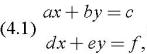
where a, b, c, d, e, and f are constants, is an example of a linear algebraic system. It is straightforward to solve this system for x and y, given the constants, with any number of methods. As will be detailed in the following chapters, several of the mesh smoothing and enhancement approaches produce, ultimately, a linear system that must be solved. These methods require solution of systems of algebraic equations. For example, in two-dimensions there are two equations per mesh node point that are free to move, one for the x coordinate and one for the y coordinate. In three dimensional problems there are similarly three equations per free node point in the discrete enhancement system. These generally large, linear equation systems have the same flavor as the simple two equation example above, differing only in scale. For these problems, a compact notation is used to represent the equation system
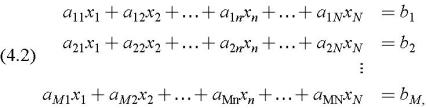
where m = 1, , M is the row index and n = 1, , N is the column index. Note that in all of the applications...


 TABLE OF CONTENTS