Mesh Enhancement: Selected Elliptic Methods, Foundations and Applications

This chapter on discretization methods provides an introduction to the techniques used both in the mesh generation and enhancement step and within the final simulation application of the numerical simulation process illustrated in Fig. 1.1. The goal is to provide sufficient mathematical background and examples to illustrate their viability and use for the simulation of physical phenomena. Additionally, this discussion provides more background on the origin of structured and unstructured meshes discussed in the rest of this book. Emphasis on the finite element method is given here in view of its extensive use in Chapter 9 on mesh enhancement for unstructured grids. Finite difference and finite volume methods are also discussed at some length to support their use in Chapter 8 on structured mesh enhancement methods.
Consider the differential initial-boundary value problem (IBVP) for u (x, t)
where x are the three space coordinates describing the three-dimensional domain
, the domain boundary is
, and t represents time.
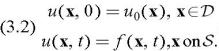
is a general, second order differential operator involving spatial derivatives of u (this may be a linear or nonlinear operator, depending on the application). The IBVP is completed by specifying u (x, t) through the initial and boundary conditions
Should
be of higher order, additional conditions would need to be specified to insure that the problem is well posed.
Such differential equations, even if relatively simple, may not have an exact solution. However, an approximate solution may be employed. Numerical solutions are based upon discretization...