Polymer Reference Book

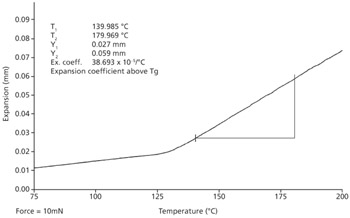
The curve in Figure 16.1 illustrates a method for determining the expansion coefficient of a polymer.
Details of this method are given in Table 16.1.
| Method | ATS FAAR Apparatus Code No. | Measurement units | Test suitable for meeting following standards | Notes |
|---|---|---|---|---|
| Temperature of deflection under load or heat deflection or distribution temperature (Martens Method) | C | ASTM D648-04 [01] | ||
| Softening point Vicat | 10.01004 10.01009 10.01003 10.01010 10.01041 10.01042 | C | ASTM D648-04 [01] ASTM D1525 [2] DIN EN ISO 306 [3] DIN EN ISO 75-1 [4] DIN EN ISO 75-2 [5] ISO 75-1 [6] ISO 75-2 [7] ISO 75-3 [8] ISO 306 [9] UNI EN ISO 75-1 [10] UNI EN ISO 75-2 [11] UNI EN ISO 75-3 [12] UNI EN ISO 306 [13] | |
| Melt flow index (or rate) | 1002013 10.02017 | ASTM D1238 [14] ASTM D2116 [15] ASTM D3364 [16] UNI EN ISO 1133 [17] | ||
| Low temperature embrittlement (or brittleness temperature) | 10.12000 10.12006 | C | ASTM D746 DIN ISO | |
| Melting point (Fischer Johns) | 070173C | C | ASTM | Also measured from differential thermal analysis peak |
| Thermal conductivity | w/mk | ASTM C177 [19] DIN 52612 [20] | ||
| Linear expansion coefficient | 10.46000 | mm/mm cm/cm per C in/in F | ASTM D696-44 [21] UNI 5284 [22] | |
| Specific heat | kJ Kg 1 | ASTM DIN | Can also be measured by differential scanning calorimetry |