Practical Guide to Polyethylene

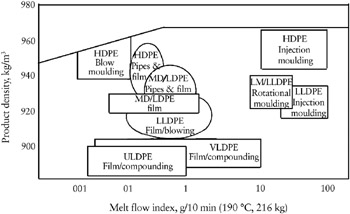
Polyethylene (PE) grades are mainly classified according to their density (Figure 2.1).
LDPE is a semi-rigid, translucent material, and was the first of the polyethylenes to be developed. It is primarily used at normal operating temperatures. Its qualities include toughness, flexibility, resistance to chemicals and weather, and low water absorption. It is easily processed by most methods and has a low cost. It is also resistant to organic solvents at room temperature. Its use is not advisable in situations where extreme temperatures are found. It is a corrosion-resistant, low-density extruded material that provides low moisture permeability. LDPE has a fairly low working temperature, soft surface, and low tensile strength. It is an excellent material where corrosion resistance is an important factor, but stiffness, high temperature, and structural strength are not important considerations.
LDPE resins are re-emerging as a valuable product family, combining superior clarity with a stiffness and density favoured by converters for downgauging. Ease of processing beyond most linear low-density PE (LLDPE) resins, combined with improved product performance, continues to give cost-competitive solutions to converters in a wide variety of film applications. These range from complex food packaging structures to shopping bags, coated paperboards, liners, overwraps, consumer bags, heavy-duty sacks, clarity shrink...