Practical Guide to Polyethylene

3.5: Mechanical Properties

3.5 Mechanical Properties

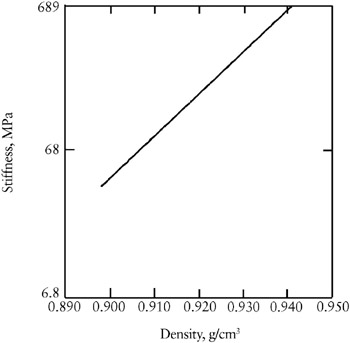
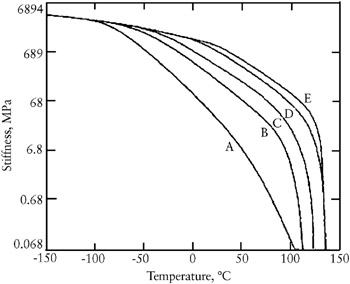
The presence of a crystalline phase enables PE to retain its mechanical strength over a large temperature range, despite the relatively low T g. Probably the most important and significant single mechanical measurement to be made on PE is the determination of elastic modulus or stiffness . The stiffness of PE increases linearly with density (Figure 3.10) and depends on temperature (Figure 3.11). It is evident from Figure 3.11 that the decrease in modulus of highly branched PE with increasing temperature follows a curve quite different from that of more dense linear polymers.


Figure 3.10: Effect of density on the stiffness (elastic modulus) of PE [33]
Drawn from the data R.A.V. Raff in Encyclopaedia of Polymer Science and Technology, published by Interscience, 1967. Copyright Wiley, 1967.

Figure 3.11: Effect of temperature on the stiffness of PE of various densities. A: 0.895 g/cm 3; B: 0.918 g/cm 3; C: 0.935 g/cm 3; D: 0.950 g/cm 3; E: 0.968 g/cm 3 [33]
Redrawn with permission from R.A.V. Raff in Encyclopedia of Polymer Science and Technology, published by Interscience, 1967. Copyright Wiley, 1967.

Yield strength, tensile strength, and elongation at break are mechanical properties that are particularly important in terms of practical applications. They represent the maximum elastic strength, the ultimate strength, and the amount that the PE can be drawn, respectively. These are commonly determined from stress strain curves (Figure 3.12).


Figure 3.12: Idealised stress strain curve for a typical crystalline olefin polymer...

UNLIMITED FREE
ACCESS
TO THE WORLD'S BEST IDEAS

SUBMIT
Already a GlobalSpec user? Log in.

This is embarrasing...

An error occurred while processing the form. Please try again in a few minutes.

Customize Your GlobalSpec Experience

Category: Polymers and Plastic Resins
Finish!
Privacy Policy

This is embarrasing...

An error occurred while processing the form. Please try again in a few minutes.