Practical Guide to Polyethylene

3.6: Electrical Properties

3.6 Electrical Properties

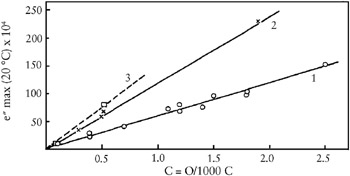
PE is an excellent electrical insulator (see Tables 3.1 and 3.9). PE grades exhibit outstandingly high resistivity, low dielectric constant, and negligible power factor, all substantially unaffected by temperature, frequency (exception is the dissipation factor), and humidity (unaffected by prolonged immersion in water) over the usual range of service conditions. Further, low values of dielectric constant can also be achieved using foamed PE. The power factor is critically dependent on the amount of catalyst residues in the polymer. Typical electrical applications of PE are as insulating material for cable and wires. During ageing, because of incorporation of oxygen-containing groups in the PE structure, the electrical properties are drastically changed, as can be seen from the variation of the dielectric loss factor with oxygen content (Figure 3.24).


Figure 3.24: Dielectric loss factor at the ? maximum at room temperature as a function of oxygen content for oxidised PE of different densities. 1: LDPE, about 20 CH 3/1000 C, ? = 0.925 g/cm 3; 2: HDPE, about 4 CH 3/1000 C, ? = 0.957 g/cm 3; 3: annealed HDPE, 2 CH 3/1000 C, ? = 0.974 g/cm 3 [23]
Reproduced with permission from Handbook of Polyolefins: Synthesis and Properties, 1st Edition, Eds., C. Vasile and R.B. Seymour, Marcel Dekker, New York, NY, USA, 1993. Copyright Marcel Dekker, 1993.

UNLIMITED FREE
ACCESS
TO THE WORLD'S BEST IDEAS

SUBMIT
Already a GlobalSpec user? Log in.

This is embarrasing...

An error occurred while processing the form. Please try again in a few minutes.

Customize Your GlobalSpec Experience

Category: Polyethylene Resins
Finish!
Privacy Policy

This is embarrasing...

An error occurred while processing the form. Please try again in a few minutes.