Reliability Modeling, Analysis and Optimization
Bringing together many of the leading experts in the field, this volume presents a broad picture of current research on system modeling and optimization in reliability and its applications.
 TABLE OF CONTENTS
 Shigeru Yamada* and Ryotaro Matsuda
Department of Social Systems Engineering,
Faculty of Engineering, Tottori University,
Tottori-shi, 680-8552 Japan
*yamada@sse.tottori-u.ac.jp
98t7055@sse.tottori-u.ac.jp
Software faults introduced by human errors in development activities of complicated and diversified software systems have occurred a lot of system failures of modern computer systems. Since these faults concern with mutual relations among human factors in such software development projects, it is difficult to prevent from software failures beforehand in the software production control. Additionally, most of these faults are detected and corrected after software failure occurrences during the testing phase.
If we can make the mutual relations among human factors1 ,2 ,3 clear, then the problem for software reliability improvement is expected to be solved. So far, several studies have been carried out to investigate the relationships among software reliability and human factors by performing software development experiments and providing fundamental frameworks for understanding the mutual relations among various human factors.4 ,5
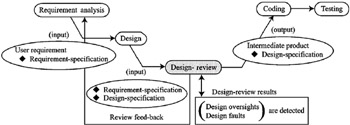
In this paper, we focus on a software design-review process which is more effective than the other processes for elimination and prevention of software faults (see Fig. 1). Then, we adopt a quality engineering approach for analyzing the relationships among the quality of the design-review activities, i.e., software reliability, and human factors to clarify the fault-introduction process in the design-review process.
We conduct a design-review experiment of graduate and undergraduate students as subjects. First, we discuss...