Sequential Statistics

Designed for students with familiarity in advanced calculus, probability and statistical inference, this text provides only elementary proofs, and maintains mathematics and statistics at a basic level.
 TABLE OF CONTENTS
 During World War II, Abraham Wald and others began working on sequential procedures and developed what is called the Sequential Probability Ratio Test procedure, which can be motivated as follows:
Neyman and Pearson (1933) have provided a method of constructing a most powerful test for a simple versus simple hypothesis-testing problem. Suppose X has p.d.f. f(x; ?) and we wish to test H 0: ?= ? 0 against H 1: ?= ? 1 .
(Neyman and Pearson, 1933). Let X 1, X 2, , X n be a random sample and also let
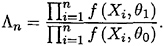
Then the most powerful test of H 0 against H 1 is obtained by rejecting H 0 if ? n ? K, and accepting H 0 if ? n< K, where K is determined by the level of significance.
Wald proposed the following sequential probability ratio test which was obviously motivated by Lemma 2.1.1: Choose two constants A and B such that 0< B< A< ?, and accept H 0 if ? n ? B; reject H 0 if ? n ? A; continue sampling if B< ? n< A when the experiment has proceeded up to stage n ( n=1, 2, ).
Consider the exponential family

where Q ( ?) is monotonically increasing in ?.
For this family the graph...