Sequential Statistics

Designed for students with familiarity in advanced calculus, probability and statistical inference, this text provides only elementary proofs, and maintains mathematics and statistics at a basic level.
 TABLE OF CONTENTS
 Suppose the statistician is interested in solving problem (i) posed in Section 4.1, that the terminal decision is an estimate for ?, and that r( ?(x); ?)= [ ?(x) ? ?] 2. In this case, if we restrict ourselves to unbiased estimates of ? we would then be interested in lower bounds for the variance of such estimates. The Cram r-Rao inequality was extended to the sequential case by Wolfowitz (1947). Towards this we need the following lemma pertaining to a random sum of i.i.d. random variable.
Let S N= X 1+ X 2+...+ X N where the X i are i.i.d.
If E(N)< ? and EX< ?, we have E(S N )=E(N)E(X).
If E(X)=0, E( X 2)< ?, and E(N)< ?, E(  )= E(N)E( X 2) .
If E[g(X)]=E[h(X)]=0, E [ g 2 (X)]< ?, E[ h 2 (X)]< ? and P(X= 0)<1, then
| (4.3.1) |  |
Notice that (i) and (ii) follow from Theorem 2.4.2. (iii) has been established by Lehmann (1950) under a different set of sufficient conditions. Consider

where Y i=1 if N ? i and zero otherwise. So, left hand expression
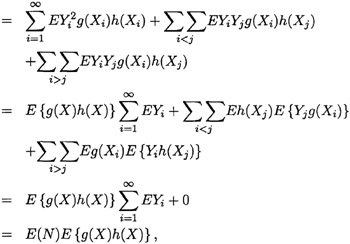
since for i< j, Y j=1 implies that Y i=1.
In order to interchange expectation and infinite summation, the series shouldbe absolutely integrable. That is