Sequential Statistics

Designed for students with familiarity in advanced calculus, probability and statistical inference, this text provides only elementary proofs, and maintains mathematics and statistics at a basic level.
 TABLE OF CONTENTS
 In Chapter 2 we have considered SPRT's to test a simple hypothesis against a simple alternative. However in practical situations the simple null hypothesis is only a representative of a set of hypotheses; the same thing can be said about the simple alternative. Thus, we are faced with the problem of testing a composite hypothesis against a composite alternative. The compositeness of the hypotheses can arise from two situations: (i) the composite hypotheses are concerned about the parameters of interest and there are no nuisance parameters, and (ii) the hypotheses may be simple or composite, but one or more nuisance parameters are present.
Let f(x; ?) denote the probability function (or probability density functions) of X, indexed by the unknown parameter ? (which may be vector-valued). In general, we wish to test the composite hypothesis H 0: ? ? ? 0 against the composite alternative H 1: ? ? ? 1. Let S 1 denote the boundary of ? 1. Wald (1947) proposed a method of "weight functions" (prior distributions) as a means to construction of an optimum SPRT. Assume that it is possible to construct two weight functions g 0 ( ?) and g 1( ?) such that
| (3.1.1) |  |
where dS denotes the infinitesimal surface element.
Then the SPRT is based on the ratio
| (3.1.2) | 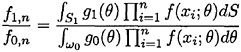 |
and satisfying the conditions:
the probability of type I error, ?( ?),