Smoothed Particle Hydrodynamics: A Meshfree Particle Method

The density approximation is very important in the SPH method since density basically determines the particle distribution and the smoothing length evolution. There are two approaches to evolve density in the conventional SPH method. The first approach is the summation density, which directly applies the SPH approximations to the density itself. For a given particle i, the density with summation density approach is written in the form of
| (4.26) | |
where N is the number of particles in the support domain of particle i, and m j is the mass associated with particle j. W ij is the smoothing function of particle i evaluated at particle j, and is closely related to the smoothing length h.
| (4.27) | |
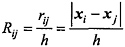
where
is the relative distance of particle i and j, and r ij is the distance between these two particles. Commonly used smoothing functions are listed in Table 3.1.
Note that W ij has a unit of the inverse of volume. Equation (4.26) simply states that the density of a particle can be approximated by the weighted average of the densities of the particles in the support domain of that particle.
Another approach of particle approximation for density is the continuity density, which approximates the density according to the continuity equation using the concepts of SPH approximations plus some transformations. Different transformation or operation on the RHS of the...