Smoothed Particle Hydrodynamics: A Meshfree Particle Method

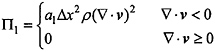
In order to simulate problems of hydrodynamics, special treatments or methods are required to allow the algorithms to be capable of modeling shock waves, or else the simulation will develop unphysical oscillations in the numerical results around the shocked region. A shock wave is not a true physical discontinuity, but a very narrow transition zone whose thickness is usually in the order of a few molecular mean free paths. Application of the conservation of mass, momentum, and energy conditions across a shock wave front requires the simulation of transformation of kinetic energy into heat energy. Physically, this energy transformation can be represented as a form of viscous dissipation. This idea leads to the development of the von Neumann-Richtmyer artificial viscosity (von Neumann and Richtmyer, 1950) that is given by
| (4.64) | |
where ? 1 is the von Neumann-Richtmyer artificial viscosity, and needs only to be present during material compression, a 1 is an adjustable non-dimensional constant. Note that this von Neumann-Richtmyer artificial viscosity is, in fact, a quadratic expression of velocity divergence.
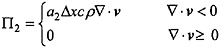
It is found that adding the following linear artificial viscosity term ? 2 has the advantage of further smoothing the oscillations that are not totally dampened by the quadratic artificial viscosity term
| (4.65) | |
where c is the speed of sound, and a 2 is an adjustable non-dimensional constant.
The quadratic von Neumann-Richtmyer artificial viscosity ? 1 and the linear artificial viscosity