Statistical Aspects of the Design and Analysis of Clinical Trials, Revised Edition
The log-rank test described in Section 8.2.1 can be extended to the case where there are either more than two patient groups to be compared or where there are possible confounding factors that may be treated as strata. But the test, and other similar tests, are limited in their ability to fully describe and model the data. Consequently, more complex analyses of survival data are usually performed using some type of specialised regression model.
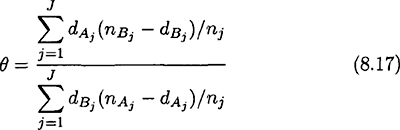
The regression models that have been developed for survival data are essentially of two types. The first models the hazard function in patient groups compared to a baseline population by means of a multiplicative model, that is to say, additive on the log-hazard scale. The multiplicative factor is assumed to be constant over time, in which case the model forces the hazards in the different patient groups to be proportional, thus yielding a proportional hazards regression model. Following Peto (1976), estimates of the hazard ratio in the two sample case (A and B) can be obtained directly from the Mantel-Haenzsel log-rank test statistic and its variance (see Section 8.2.1). Alternatively, following Mantel and Haenzsel (1959), it may be estimated as:
The second type of regression model commonly applied to survival data, models the survival times directly, with covariates assumed to act multiplicatively directly on the time scale, thus accelerating or decelerating time to failure. The models are generally referred to as accelerated failure time models.
Within each of these...