Tensor Analysis
Suitable for students and practicing engineers, this concise text provides a straightforward treatment of those formulas needed to describe objects in three-dimensional space.
 TABLE OF CONTENTS
 We have met sets of quantities like g ij or g ij. Such a table of 3 3=9 coefficients could be considered as a vector in a nine-dimensional space, but we must reject this idea for an important reason: if we change the frame vectors and calculate the relations between the new and old components, the results differ in form from those that apply to vector components. The components of the metric tensor transform according to certain rules, however, and it is found that these transformation rules also apply to various quantities encountered in physical science. We indicated in Chapter 1 that these quantities, represented by 3 3 matrices, form a class of objects known as tensors of the second rank. Our plan is to present the relevant theory in a way that parallels the vector presentation of Chapter 2.
We begin to realize this program with the introduction of the dyad (or tensor product) of two vectors a and b, denoted a ? b. We assume that the tensor product satisfies the usual properties of a product
| (3.1) | 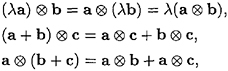 |
where ? is an arbitrary real number. From now on, however, we shall write out the dyad without the ? symbol: ab= a ? b.
Let us once again consider the space of three-dimensional vectors with the frame e i. Using the expansion of the vectors in the basis vectors and the properties (3.1), we represent...