Tensor Analysis
Suitable for students and practicing engineers, this concise text provides a straightforward treatment of those formulas needed to describe objects in three-dimensional space.
 TABLE OF CONTENTS
 At each point of a surface there is defined the frame triad

In the theory of shells they introduce the curvilinear coordinates in a neighborhood of the surface in such a way that on the surface the triad ( r 1, r 2, n) is preserved. Since we need to find different characteristics of fields given on the surface and outside of it we need to find the derivatives of the triad with respect to the coordinates. The goal of this section is to present these in terms of the surface we have introduced: that is, in terms of the first and second fundamental forms of the surface.
We start with the representation for the derivatives through the Christoffel notation. This is valid because, by assumption, ( r 1, r 2, n) is a basis of the space of vectors. So
| (5.36) |  |
We recall that we use indices i, j, t taking values from the set {1, 2}, which is why we introduce the notation ? ij for the coefficients at n. Similarly let us introduce the expansion for the derivatives of n. To derive the coefficients ? ij we dot multiply (5.36) by n. Using the expressions for the second fundamental form we get

Next, dot multiplying (5.36) first by r 1 and then by r 2 we get six equations in the six unknown Christoffel symbols:
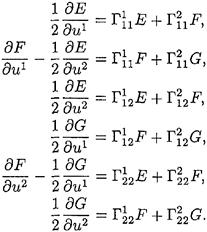
This system can be easily...