Tensor Analysis
Suitable for students and practicing engineers, this concise text provides a straightforward treatment of those formulas needed to describe objects in three-dimensional space.
 TABLE OF CONTENTS
 Surfaces of revolution are quite frequent in practice. Suppose that the surface is formed by rotation of the profile curve
| (5.50) |  |
in the xz-plane about z-axis (Fig. 5.3). When we fix u we get a circle having center on the z axis; it is called a parallel. To define a point on the parallel we introduce the angle of rotation v from the xz-plane. When we fix v we get a meridian, a curve congruent to the initial curve (5.50).
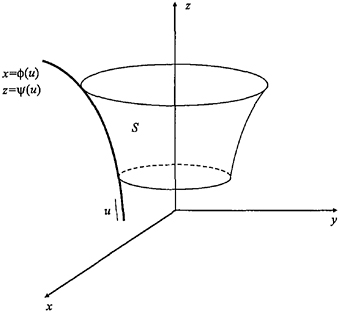
It is easy to see that the equations of the surface of revolution corresponding (5.50) are

Let us find the coefficients of the first fundamental form of the surface:

Note that F=0 means the orthogonality of the parameterization net. Thus the first fundamental form is

For the components of the second fundamental form we have

and
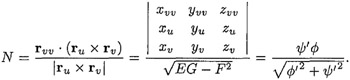
Thus the second fundamental form is

We see that M=0, which means that the coordinate lines are conjugate. [6] Thus the coordinate lines of a surface of revolution are the lines of curvature.
|
| Exercise 5.37 Find the principal curvatures of the surface of revolution. |
|
| Exercise 5.38 Find the first and second fundamental forms for (a) the plane, and (b) the sphere. |
|
| Exercise 5.39 Find the first and second fundamental forms for each of the following paraboloids: (a) |