Thermal Degradation of Polymeric Materials
Polyolefins are some of the largest-volume commodity polymers and are produced with a variety of processes. This results in a wide range of polyolefin grades, differing in tacticity, morphology, degree of branching, molecular-weight distribution and other properties such as thermal stability, which can require significantly different stabiliser formulations [a.1, a.2] {886353} {815959} {751920}. Thermal degradation of polyolefins has been described by a number of researchers, some of whose recent data are described in the subsequent sections.
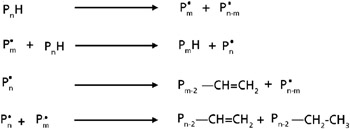
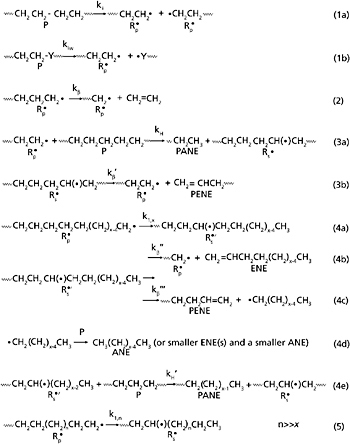
The thermal degradation of polyethylene (PE) occurs by random chain scission {886343} {877171} {831619} {670581} [a.388] (Scheme 1), producing small amounts of the monomer (ethylene), and the degradation proceeds by a free-radical mechanism (Scheme 2) [a.53].

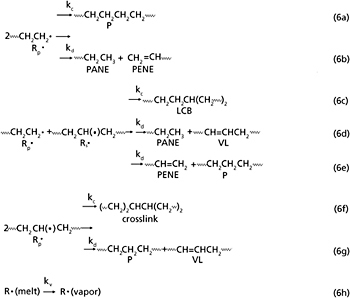
Main-chain cleavage to form chain-terminal radicals is the initiation step. Intramolecular hydrogen abstraction by primary radicals, i.e., backbiting, occurs to an appreciable extent, which explains the preferential formation of some products such as C 6, C 10 and C 14 hydrocarbons. However, the rates of the various elementary steps involved in the whole reaction have not yet been determined, and the details of hydrogen transfer during the formation of molecular fragments from a macroradical in the polymer melt are also not clear. The usual initiation, propagation and termination steps are illustrated in Scheme 2 with weak links (step...