5.2.1 Polystyrene (PS) and its Chemical Modifications
Polystyrene (PS) is a large-volume, commodity polymer with a broad range of uses, e.g., in food packaging applications {815959} {428809}. Numerous studies of the thermal degradation of PS with different tacticities (aPS, sPS and iPS) and their chemical modifications have been reported and the predominant mechanism is accepted to be that of random chain scission followed by intermolecular transfer, with smaller amounts of unzipping and intramolecular transfer ( Schemes 4 and 5) {888059} {581327} {860868} {724282} {594526} [a.70].
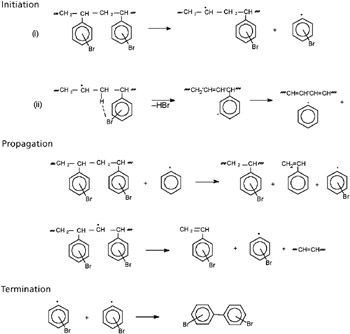 Scheme 4: Brominated PS thermal degradation via a free-radical mechanism
 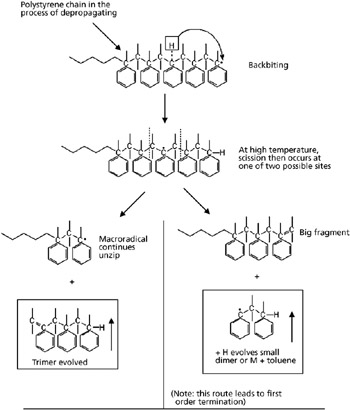 Scheme 5: A probable intramolecular transfer (backbiting) step in the thermal degradation of polystyrene. Other backbites can occur with rather smaller probability
Reprinted from {594526} with permission from Elsevier Complete volatilisation is usual and, depending upon precise conditions, monomer yield may be up to 40%, with the balance made up mostly of dimers and trimers. Structural irregularities are thought to be important as initiation sites, and, in the more regular anionically synthesised polymer, initiation of degradation has been reported to occur at the terminal benzyl group [a.71].
During typical thermal degradation experiments, measuring the mass of remaining polymer and analysing the volatile products evolved serve to monitor reaction progress {7045893} {688694} {583706} [a.72, a.73]. Thus, the rates of multiple processes, such as random scission, chain-end scission, vaporisation, diffusion, repeated initiation/recombination and vapour-phase reactions, are usually lumped into one rate coefficient. Among structural features, regioregularity may play...

 TABLE OF CONTENTS