Thermal Degradation of Polymeric Materials
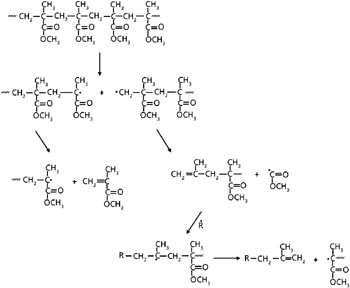
Thermal degradation of an acrylic polymer, polymerised using a free-radical method, proceeds in three steps of mass loss: the first and easiest (Scheme 19(1)) is initiated by scissions of head-to-head linkages at about 160 C (representing one type of defect at the polymer backbone); the second (Scheme 19(2)) by scissions at the chain-end initiation from vinylidene ends at around 270 C; and the last (Scheme 19(3)) by random scission within the polymer chain (at the weakest bonds) {894653} {805908} {784305} {737106} {711105} {630026} {600788} [a.442].
Since this polymer is widely used, e.g., in orthopaedic surgery, fracture fixation, human body implantations and as a filler in irregularly shaped skeletal defects or voids, a considerable amount of work has been dedicated to the thermal degradation of PMMA {893911} {884331} {857011} {827195} {803123} {753900}. The rate of thermal degradation has been found to depend upon the initial degree of polymerisation of the polymer, the dependence of which has been used to identify the mechanisms of thermal degradation, e.g., a radical one (Scheme 20) [a.8].
It has also been reported [a.159] {863996} that some degradation occurs by side-group elimination, leading to the formation of unsaturated products. It has also been claimed that side-group elimination is a more dominant process than chain scission initiation, ...