Waves and Wave Forces on Coastal and Ocean Structures: Advanced Series on Ocean Engineering, Volume 21

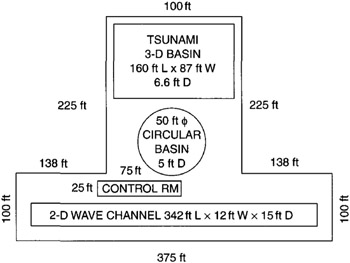
Wavemaker theories play several important roles in coastal and ocean engineering. Havelock (1929) published the first wavemaker theory and applied Fourier integrals to develop a theory for forced surface gravity waves in waters of both infinite and finite depths. Wavemaker theories for both planar and circular wavemakers were derived. The most important and obvious role for wavemaker theories is the applications to laboratory wavemakers for both wavemaker designs and wave experiments. These applications include planar wavemakers for 2D wave channels, planar wavemakers for 3D wave basins, directional wavemakers for directional wave basins and circular wavemakers for circular wave basins. An example of a modern wave research laboratory that has all three of these types of wavemakers and wave channels/basins is the O.H. Hinsdale-Wave Research Laboratory (OHH-WRL) that is located on the campus of Oregon State University in Corvallis, OR and that is illustrated in Fig. 5.1 (the 160 ft (L) 87 ft (W) 6.6 ft (D) 3D tsunami basin has a segmented wavemaker that operates both as a 2D planar and a 3D directional wavemaker). Operations of wave research laboratories and physical modeling in wave laboratories are reviewed by Chakrabarti (1994) and by Hughes (1993).
A second but equally important role for wavemaker theories is an application for computing a scalar radiated wave potential to compute the wave induced loads on large Lagrangian solid...