Waves and Wave Forces on Coastal and Ocean Structures: Advanced Series on Ocean Engineering, Volume 21

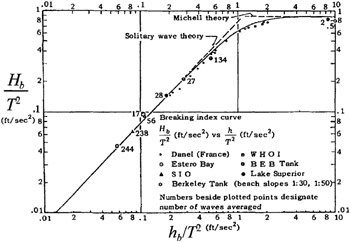
Both theoretical and empirical estimates for breaking waves are available. Reid and Bretschneider (1953) combine both theoretical and empirical breaking wave estimates to form a breaking index curve over three decades of dimensional water depth from deep- to shallow-water on the dimensional H b /gT 2 ?hb/gT 2 dissection plane illustrated in Fig. 6.11. Separate theoretical wave breaking estimates are required for deep- and shallow-water as illustrated in Fig. 6.11, where the deep-water estimates are identified as Michell theory and are independent of the water depth h, and where the shallow-water estimates are identified as Solitary wave theory and vary linearly on the logarithmic axes with the depth of breaking h b . Empirical estimates connect these two theoretical estimates in deep- and shallow-water over one decade of the dimensional breaking depth h b /T 2 between 0.3< hb/T 2 <3.0.
Theoretical Wave Breaking Criteria
Two theoretical criterion have been identified to determine wave breaking; viz., kinematic and dynamic. Dean (1974) tabulates the relative error between the Dean Stream Function Theory and linear wave theory for each criterion.
Kinematic Wave Breaking Parameter ? K
The kinematic wave breaking parameter is the ratio of the maximum horizontal water particle velocity u C at the wave crest ? C to the wave celerity C given by
Dynamic Wave Breaking Parameter ? D
The dynamic wave breaking parameter is...