Handbook of Face Recognition

Containing a comprehensive account of face recognition research and technology, this handbook provides coverage of the concepts, methods, and algorithms for automated face detection and recognition.
 TABLE OF CONTENTS
 Sami Romdhani [1], Volker Blanz [2], Curzio Basso [1], and Thomas Vetterz [1]
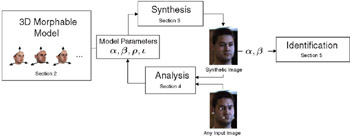
Our approach is based on an analysis by synthesis framework. The idea of this framework is to synthesize an image of a face that resembles the face in an input image. This framework requires a generative model able to accurately synthesize face images. The parameters of the image generated by the model are then used for high-level tasks such as identification.
To be applicable on any input face image, a good model must be able to generate any face images. Face images vary widely with respect to the imaging conditions (illumination and angle from which the face is viewed, called pose) and with respect to the identity and the expression of the face. A generative model must not only allow for these variations but must also clearly separate the source of variations to make, say, identification tasks invariant to the other sources of variation.
We explain in this section that a thrre-dimensional (3D) representation enables the accurate modeling of any illumination and pose as well as the separation of these variations from the rest (identity and expression). The generative model must be able to synthesize images from any individual. In a morphable model, the identity variation is modeled by making linear combinations of faces of a small set of persons. In this section, we show why linear combinations yield a realistic face only if the set of...