Handbook of Face Recognition

Containing a comprehensive account of face recognition research and technology, this handbook provides coverage of the concepts, methods, and algorithms for automated face detection and recognition.
 TABLE OF CONTENTS
 Stan Z. Li [1] and Anil K. Jain [2]
Face recognition is a task that humans perform routinely and effortlessly in their daily lives. Wide availability of powerful and low-cost desktop and embedded computing systems has created an enormous interest in automatic processing of digital images and videos in a number of applications, including biometrie authentication, surveillance, human-computer interaction, and multimedia management. Research and development in automatic face recognition follows naturally.
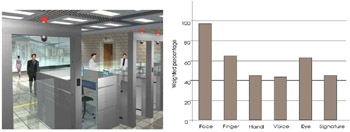
Research in face recognition is motivated not only by the fundamental challenges this recognition problem poses but also by numerous practical applications where human identification is needed. Face recognition, as one of the primary biometrie technologies, became more and more important owing to rapid advances in technologies such as digital cameras, the Internet and mobile devices, and increased demands on security. Face recognition has several advantages over other biometrie technologies: It is natural, nonintrusive, and easy to use. Among the six biometrie attributes considered by Hietmeyer [12], facial features scored the highest compatibility in a Machine Readable Travel Documents (MRTD) [18] system based on a number of evaluation factors, such as enrollment, renewal, machine requirements, and public perception, shown in Figure 1.1.
A face recognition system is expected to identify faces present in images and videos automatically. It can operate in either or both of two modes:...