Power Management in Mobile Devices

High performance usually requires power sacrifices. The objective is to find the perfect balance between the two within a particular design. Optimize for performance when speed is an absolute must and target everything else for low power. There are a number of design and process strategies for achieving economical performance at system-level, chip-level, and even transistor-level designs, to achieve performance with long battery life.
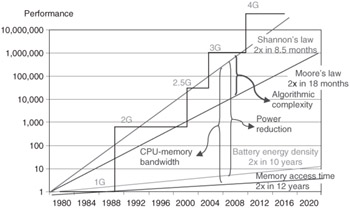
Figure 2.1 summarizes the key challenges facing the mobile device industry. The step function labeled 1G, 2G, 3G, and 4G depicts the gains in cellular transmission over time. This follows Shannon's law that predicts two times the transmission performance improvement in 8.5 months. Given Moore's law, it takes semiconductor manufacturers 18 months to double the number of transistors and therefore double the microprocessor performance. In addition, it takes battery makers 5 10 years to achieve comparable increase in power density. Also memory access time performance doubles every 12 years.
The gaps define the challenges faced by the mobile device industry. They include:
Microprocessor and memory bandwidth gap
Power reduction gap
Algorithmic complexity gap
These gaps are the major hurdles to successful commercialization of mobile devices. In order to provide the advanced features and services required in future networks, system performance, as predicted by Shannon's law of Algorithm Complexity, must improve at a rate faster than Moore's law without compromising power budgets.
This has traditionally been tackled in the mobile device by making...