2008+ Solved Problems in Electromagnetics

Chapter 1: Vector Analysis

Vectors and Scalars/Unit vectors/Scalar Componets and Vector Components/Vectorial Areas/Dot Product/Vector Fields and Scalar Fields/The Gradient Vector/Line Integrals/Divergence and the Divergence Theorem/Curl and Stokes' Theorem/Potential Functions and Conservatives Fields

Solved Problems 1 50

1.1 Quantities having magnitude only are called scalars, and those having magnitudes and directions are called vectors. Classify:

  1. 20 C temperature in a room;

  2. 50 N centripetal force;

  3. 60 km/h speed of an automobile;

  4. 60 km/h horizontal velocity of an automobile;

  5. $100 in $1 bills.

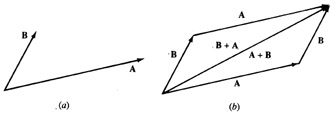
1.2 A vector may be represented by a directed line segment. Show how the two vectors given in Fig. 1-1( a) may be added together.


Figure 1-1

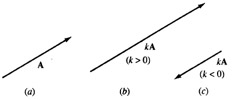
1.3 For the vector A of Fig. 1-2( a), draw the vector k A for k > 0 and k < 0.


Figure 1-2

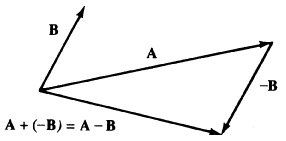
1.4 Obtain the vector A - B for the vectors A and B given in Fig. 1-1.


Figure 1-3

1.5 We define unit vectors a x, a y, and a z in a rectangular coordinate system as vectors of length 1 and directed along the x, y, and z axes, respectively. Given A x, A y, and A z, the scalar components (projections) of a vector A along the three axes, express A in terms of these components and unit vectors.

1.6 A vector A has beginning...

UNLIMITED FREE
ACCESS
TO THE WORLD'S BEST IDEAS

SUBMIT
Already a GlobalSpec user? Log in.

This is embarrasing...

An error occurred while processing the form. Please try again in a few minutes.

Customize Your GlobalSpec Experience

Category: Magnetometers
Finish!
Privacy Policy

This is embarrasing...

An error occurred while processing the form. Please try again in a few minutes.