2008+ Solved Problems in Electromagnetics

Solved Problems 151 200

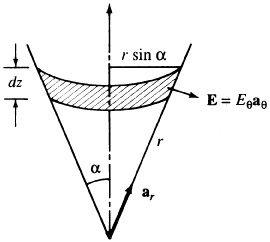
2.151 The potential outside of the conducting cone ? = ? (Fig. 2-44) is given by V = In cot ( ?/2). Determine the surface charge per unit length in the z direction.


Figure 2-44

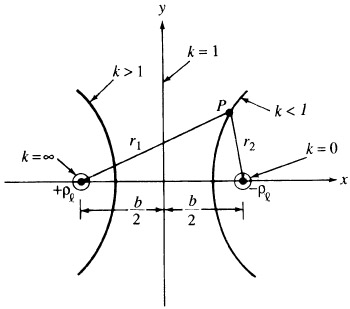
2.152 Two infinite line charges, ? ?, run parallel to the z axis, a distance b apart. Find the equipotential curves in the xy plane.


Figure 2-45

2.153 Consider two concentric spheres. The inner sphere has radius a, and a charge + Q is distributed uniformly over its outer surface. The outer sphere has radius b, and a charge - Q is distributed uniformly over its inner surface. Determine the potential difference between the two spheres.

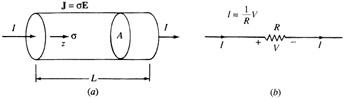
2.154 A cylindrical conductor and its resistive analog are respectively shown in Fig. 2-46( a) and ( b). Ohm's law for the two representations is stated as J = ? E and I = V/R, where J is the current density vector in the conductor and ? is its conductivity. Assuming J constant in magnitude and direction across the conductor cross section, obtain an expression for R in terms of L, A, and ?.


Figure 2-46

2.155 In Fig. 2-47, two point charges + q and - q separated by a small distance s = s constitute an (extended)

UNLIMITED FREE
ACCESS
TO THE WORLD'S BEST IDEAS

SUBMIT
Already a GlobalSpec user? Log in.

This is embarrasing...

An error occurred while processing the form. Please try again in a few minutes.

Customize Your GlobalSpec Experience

Category: I/Q Modulators and I/Q Demodulators
Finish!
Privacy Policy

This is embarrasing...

An error occurred while processing the form. Please try again in a few minutes.