2008+ Solved Problems in Electromagnetics

TEM Field Structure/The (Lossless) Transmission-Line Equations/Propagation Velocity and Characteristic Resistance/Voltage and Current Reflection/Steady-State Analysis/Complex Voltage Reflection Coefficient; Input Impedance; Electrical Length/Crank Diagram/VSWR/Electrically Short Lines/The (Lossy) Transmission-Line Equations/Propagation Constant and Characteristic Impedance/Per-Unit-Length-Parameters/Normalized Impedance and the Smith Chart
|
| 6.1 A transverse electromagnetic ( TEM) field structure is one in which the electric and magnetic field vectors at each point in space have no components in the direction of propagation. Verify that a coaxial cable (Fig. 6-1) supports the TEM mode. Figure 6-1 |
|
|
| 6.2 Apply Maxwell's equations in integral form to the TEM mode, using a contour C xy and a surface S xy in an xy plane of Fig. 6-1. Show that these Maxwell's equations reduce to those for static fields. |
|
|
| 6.3 What conclusions may be drawn from Problem 6.2? |
|
|
| 6.4 Relate the voltage V( z, t) between the two conductors of the cable of Fig. 6-1 and the current I( z, t) along the cable to the E- and H-fields, and show that the voltage and the current are uniquely defined. |
|
|
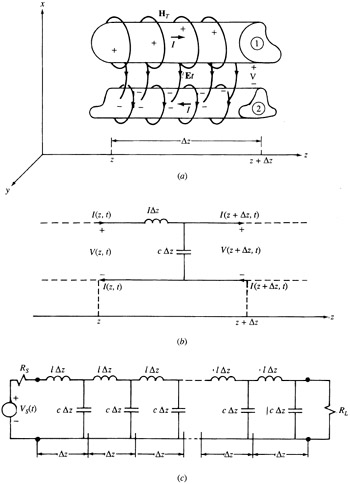
| 6.5 A portion of a two-conductor, uniform transmission line is shown in Fig. 6-2( a), which also shows the H- and E-fields. Characterize this section of the line via a lumped inductance and a lumped capacitance. Figure 6-2 |
|
|
| 6.6 Obtain a pair of equations giving the voltage-current relationship for the... |