3G Wireless Demystified
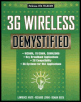
Telecom experts provide the big picture of 3rd Generation universal mobile telecommunication systems (UMTS).
 TABLE OF CONTENTS
 The first generation of cellular systems used analog radio technology. Analog cellular systems consist of three basic elements: a mobile telephone (mobile radio), cell sites, and a mobile switching center (MSC). Figure 2.1 shows a basic cellular system in which a geographic service area such as a city is divided into smaller radio coverage area cells. A mobile telephone communicates by radio signals to the cell site within a radio coverage area. The cell site s base station (BS) converts these radio signals for transfer to the MSC via wired (landline) or wireless (microwave) communications links. The MSC routes the call to another mobile telephone in the system or the appropriate landline facility. These three elements are integrated to form a ubiquitous coverage radio system that can connect to the public switched telephone network (PSTN).

Nippon Telephone and Telegraph (NTT) in Tokyo started the first commercial analog cellular system on December, 1979 [[1]]. In 1981, the commercial Nordic Mobile Telephone (NMT) system was started in the Nordic countries [[2]]. Although there was an Advanced Mobile Phone Service (AMPS) test system operating in 1979, the first commercial AMPS system was not introduced in the United States until 1983. By 1985, a commercial TACS system began in the United Kingdom [[3]]. Since their introduction, these first generation analog cellular technologies have evolved to provide higher system capacity and advanced features.
[[1]]Balston, D.M., Cellular Radio Systems, Artech House, MA,...