Adhesion of Polymers
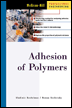
Providing in-depth coverage of properties, techniques, and step-by-step methods, this valuable sourcebook gives you the most comprehensive coverage available to create, apply, and analyze these critically important substances.
 TABLE OF CONTENTS
 The strength and serviceability of adhesive-bonded joints are mainly the result of the play of forces of intermolecular interaction between the adhesive and the substrate. The forces of interaction between two condensed bodies at distances on the atom size scale can produce high adhesion strength [1, 2]. For example, calculations performed by Joraelachvili and Tabor [3] showed that when cementing materials with high surface energy the adhesion strength must be 170.0 MPa. With a gap between the contacting surfaces of 4 10 -10 m [4] the force of interaction between them is 115.3 MPa for a Teflon-polyamide couple, 113.9 MPa for a polyamide-polyamide couple, 434.0 MPa for a Teflon-metal couple, and 569.0 MPa for a polyamide-metal couple. The values presented substantially exceed the usual adhesion and cohesion strengths determined for polymers, although only dispersion forces between contacting surfaces were taken into account in the calculations. Taking high values of the interaction forces into account, some researchers consider that failure of adhesive-bonded joints must always be of the cohesion type [5].
The reason for the lack of concordance between the theoretically and experimentally determined values of the adhesion strength lies in the fact that the process of achieving high adhesion strength is hindered by a number of phenomena that accompany the formation of adhesive-bonded joints. These factors that decrease the strength of adhesive-bonded joints can be divided into two groups:
Weak layers on the boundary between the adhesive and the substrate.
Internal stresses of the adhesive-bonded joint.
Weak layers...