Adhesion of Polymers
Providing in-depth coverage of properties, techniques, and step-by-step methods, this valuable sourcebook gives you the most comprehensive coverage available to create, apply, and analyze these critically important substances.
 TABLE OF CONTENTS
 An interpenetrating network (IPN) can be defined as a mixture of two crosslinked polymers when at least one of them is synthesized and (or) crosslinked with another [114]. The components that make up an IPN are thermodynamically incompatible and a transition region of two phases is formed in such a system. The whole complex of IPN properties is determined by the availability and features of this region.
Let us consider the properties of an adhesive based on the following mixture of oligomers: an unsaturated polyester resin and a prepolymer with end isocyanate groups (or macrodiisocyanate) based on polydiethylene glycol adipate of molecular weight 800 and on TDI (a mixture of the 2,4- and 2,6-isomers in ratio of 65:35), with the surfactant ATG added. The adhesive is cured by the effect of a redox system, for which MEKP(O) and CN are commonly used.
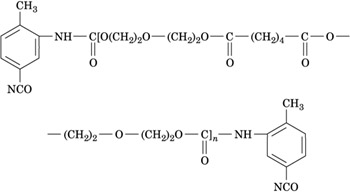
The "Sprut-5M" adhesive consists of unsaturated polyester resin 100 parts by weight, ATG-M 80 parts (a mixture of 50 parts of macrodiisocyanate and 30 parts of ATG), polymerization initiator (MEKP(O)) 2 parts. Usually 1 wt% of CN is integrated additionally into the adhesive base. Sprut-5M can be produced using various polyester resins, but the most applicable one is the adhesive based on PM-I resin owing to its availability and low cost. For this reason we will consider the properties of the adhesive based mainly on this resin although it has adhesion strength 20-40% lower than that of adhesives based on PN-11,...