Adhesion of Polymers
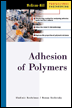
Providing in-depth coverage of properties, techniques, and step-by-step methods, this valuable sourcebook gives you the most comprehensive coverage available to create, apply, and analyze these critically important substances.
 TABLE OF CONTENTS
 Control of adhesion interaction by the addition to adhesives of surface-active substances (surfactants) is of great theoretical and practical interest. The particular effects of surfactants lie in their ability to decrease the surface tension of the solution due to positive adsorption on the surface. Coating the surface of solid bodies and of liquids with the finest layer of a surfactant added to the system in very small quantities permits changes of the conditions of phase interaction and the progress of the physical-chemical processes.
Increase of adhesion strength is observed when there is adsorption of a monolayer of surfactant, for example, of a fatty acid, between the adhesive and the substrate. The monolayer can be applied by the Langmuir method, by a mechanical-chemical procedure that consists in polishing the metal surface using pastes based on the particular surfactant, or by dipping the specimens into the surfactant solution. The results obtained are explained by the fact that in the case of adsorption of diphilic molecules there appear areas of close-packed molecules that prevent formation of the weak boundary layers. Using tagged stearic acid it was determined that the failure of polyethylene-metal adhesive-bonded joints with the metal coated with a monolayer of stearic acid is always accompanied by cohesion failure of the polyethylene. In the region close to the substrate modified by surfactant a high degree of order of the polymer is observed.
Microscopic study of the cross-section of polyethylene...