Advanced Global Illumination, Second Edition

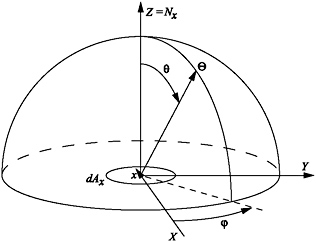
In photorealistic rendering, one often wants to work with functions defined over a hemisphere (one-half of a sphere), centered around a surface point. A hemisphere consists of all the directions in which one can look when standing at the surface point: one can look from the horizon all the way up to the zenith and all around. A hemisphere is therefore a two-dimensional space, in which each point on the hemisphere defines a direction. Spherical coordinates are a useful way of parameterizing the hemisphere.
In the spherical coordinate system, each direction is characterized by two angles (Figure B.1). The first angle, ?, represents the azimuth and is measured with regard to an arbitrary axis located in the tangent plane at x; the second angle, ?, gives the elevation, measured from the normal vector N x at surface point x. Writing directions using capital Greek letters, we can express direction ? as the pair ( ?, ?).
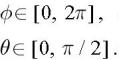
The values for the angles ? and ? belong to the intervals
So far, we have defined directions (or points) on the hemisphere. If we want to specify every three-dimensional point in space (not only points on the hemisphere), a distance r along the direction ? is added. Any three-dimensional point is then defined by three coordinates ( ?, ?, r). The transformation between Cartesian coordinates and spherical coordinates (place x