Advanced Global Illumination, Second Edition
Let s start with an overview of the classic radiosity method.
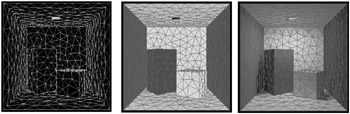
The basic idea of the classic radiosity method is to compute the average radiosity B i on each surface element or patch i of a three-dimensional model (see Figure 6.1). The input consists of a list of such patches. Most often, the patches are triangles or convex quadrilaterals, although alternatives such as quadratic surface patches have been explored as well [2]. With each patch i, the self-emitted radiosity
(dimensions: [W/m 2]) and reflectivity ? i (dimensionless) are given. The self-emitted radiosity is the radiosity that a patch emits on its own, even if there were no other patches in the model, or all other patches were perfectly black. The reflectivity is a number (for each considered wavelength) between 0 and 1. It indicates what fraction of the power incident on the patch gets reflected (the rest gets absorbed). These data suffice in order to compute the total emitted radiosity B i (dimensions: [W/m 2]) by each patch, containing the radiosity received via any number of bounces from other patches in the scene, as well as the self-emitted radiosity.