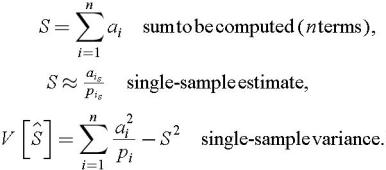
In this appendix, we show how the variance of the incremental shooting iterative algorithm of Section 6.3 can be analyzed, and demonstrate how a number of practical results can be derived from it. The analysis of the other algorithms is very similar and is a recommended exercise for the interested reader.
We start with the derivation of the variance of the incremental shooting iterative algorithm. The first thing to point out is that the resulting radiosities are obtained as the sum of increments computed in several iteration steps. We first derive the variance of a single iteration and next show how the variance on the converged results is composed from the single-iteration variances.
Variance of a single incremental shooting iteration. The variance of a single incremental shooting iteration can be derived by straightforward application of the definition of Monte Carlo summation variance:
For N samples, the variance is V [ ?] /N .
The sum to be estimated here is given in Equation 6.11. The probabilities p for picking terms from the sum are in Equation 6.12. The resulting single-sample variance of the kth incremental shooting iteration is
The latter term is usually negligible compared to the former  .
.
Variance of a sequence of incremental shooting iterations until convergence. The solution P i is eventually obtained as a sum of increments  computed in each iteration step. The single-sample variance on each increment is given above in Equation C.1. Assuming that subsequent...
Copyright A K Peters, Ltd. 2006 under license agreement with Books24x7


 TABLE OF CONTENTS