Applied Numerical Linear Algebra

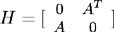
We discuss perturbation theory (in section 5.2), algorithms (in sections 5.3 and 5.4), and applications (in section 5.5 and elsewhere) of the symmetric eigenvalue problem. We also discuss its close relative, the SVD. Since the eigendecomposition of the symmetric matrix
and the SVD of A are very simply related (see Theorem 3.3), most of the perturbation theorems and algorithms for the symmetric eigenproblem extend to the SVD.
As discussed at the beginning of Chapter 4, one can roughly divide the algorithms for the symmetric eigenproblem (and SVD) into two groups: direct methods and iterative methods. This chapter considers only direct methods, which are intended to compute all (or a selected subset) of the eigenvalues and (optionally) eigenvectors, costing O( n 3) operations for dense matrices. Iterative methods are discussed in Chapter 7.
Since there has been a great deal of recent progress in algorithms and applications of symmetric eigenproblems, we will highlight three examples:
A high-speed algorithm for the symmetric eigenproblem based on divide-and-conquer is discussed in section 5.3.3. This is the fastest available algorithm for finding all eigenvalues and all eigenvectors of a large dense or banded symmetric matrix (or the SVD of a general matrix). It is significantly faster than the previous "workhorse" algorithm, QR iteration. [17]
High-accuracy algorithms based on the dqds and Jacobi algorithms are discussed in sections 5.2.1, 5.4.2, and 5.4.3. These algorithms can find tiny eigenvalues (or singular values) more accurately than alternative algorithms like divide-and-conquer,...