Applied Numerical Linear Algebra

We begin with a one-dimensional version of Poisson's equation,
where f( x) is a given function and v( x) is the unknown function that we want to compute. v( x) must also satisfy the boundary conditions [24] v( 0) = v(1) = 0. We discretize the problem by trying to compute an approximate solution at N + 2 evenly spaced points x i between 0 and 1: x i = ih, where
and 0 ? i ? N + 1. We abbreviate v i = v( x i) and f i = f( x i). To convert differential equation (6.1) into a linear equation for the unknowns v 1, , v N, we use finite differences to approximate
Subtracting these approximations and dividing by h yield the centered difference approximation
where ? i, the so-called truncation error, can be shown to be
. We may now rewrite equation (6.1) at x = x i as
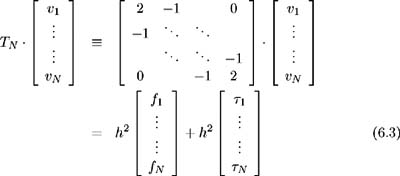
where 0 < i < N+1. Since the boundary conditions imply that v 0 = v N+1 = 0, we have N equations in N unknowns v 1, , v N:
or
To solve this equation, we will ignore ?, since it is small compared...