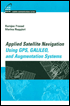
Applied Satellite Navigation Using GPS, GALILEO, and Augmentation Systems
Navigation is the process that drives a person during his or her movement between two points, enabling an ancient dream of the human race: the knowledge of position at any given time. This need derives from the spirit of discovery and exploration that every human being has, a sign of our common essence:
Considerate la vostra semenza:
fatti non foste a viver come bruti,
ma per seguir virtute e canoscenza.Think of the roots from which you sprang, and show
that you are human, not unconscious brutes
but made to follow virtue, and to know.Dante Alighieri, La Divina Commedia, Inferno, Canto XXVI
We have maps that show the Earth, we have conquered the space around the Earth, and we have conquered the Moon; we are working to conquer the rest of the universe.
We cannot live without journeying and each journey, be it either only a few kilometers long or to where none has been before, needs support to reach the right location.
Terrestrial navigation has relied for millenniums on maps, signs, and the human sense of direction [1, 2]; it is only in recent times that radio signals have helped land navigation. The most important tools for navigation were created to ensure safety during maritime journeys.
The first infrastructure created as a navigational aid was the lighthouse. The world s first lighthouses were erected about 2,000 years ago: the Colossus on the Rhodes Island in Greece and Pharos at Alexandria in...