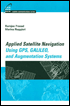
Applied Satellite Navigation Using GPS, GALILEO, and Augmentation Systems
In the last decade air traffic has been characterized by a significant yearly growth that resulted in a dramatic increase in delays and compromised safety and efficiency in the air traffic environment. This growth is predicted to continue at a rate of 2.5% per year over the next few years [1, 2]. Therefore, radical measures are required to deal with the negative impacts of the growth in air traffic. This has led to a necessity to design and develop a new ATM concept called Free Flight to optimize the use of the airspace. It is a concept for future ATM that aims at increasing system capacity, improving safety standards, and fully using capacity resources to provide a significant enhancement in the efficiency of ATM.
The Free Flight concept has been around since the early 1990s, but the FAA officially showed its interest when it established a special task force to study and develop the project, named the Radio Technical Commission for Aeronautics (RTCA) Free Flight Task Force. The Free Flight concept was defined in 1995 in the official report of the RTCA as [3]:
A safe and efficient flight operating capability under Instrument Flight Rules (IFR) in which the operators have the freedom to select their path and speed in real time.
RTCA, 1995
NASA is participating in the research on free flight by developing a far-term concept of operations, the distributed air/ground traffic management (DAG TM). In particular,...