Bottom-Line Automation, 2nd Edition

As the weaknesses of the traditional cost accounting systems began to become apparent, initiatives to rectify these systems were attempted. One of the first involved trying to revise the allocation algorithms for overhead costs to make them better reflect the manufacturing operations. Manufacturers quickly found out that this approach was futile. "It is an illusion that changing the basis of allocation will solve all cost management problems." [8] Perhaps the most visible and widely accepted approach to modifying cost accounting was based on the concept of "activity-based costing" and went under the general banner of "cost management systems" (CMS).
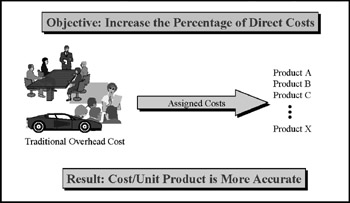
The primary objective of the CMS approach is to "fix" cost accounting so that more accurate cost data can be determined. The basis for the fix is that too much overhead cost has to be allocated to provide the cost information with any accuracy. Management could "no longer accept an environment where cost accounting contributes to overhead rates so high as to obscure true product costs." [9] The theory behind this movement was that if more of the costs in an operation could be directly assigned to a product or product line, less would have to be allocated (figure 4.4). The resulting cost information should more accurately reflect the true cost of the operation and the products.
From a cost accounting perspective, there is considerable merit to the idea and approach of activity-based costing since it should lead...