Broadband Telecommunications Handbook, Second Edition
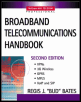
A blockbuster overview of broadband updated and expanded to reflect the latest technologies.
 TABLE OF CONTENTS
 One of the major problems facing the incumbent local exchange carriers (ILEC) is the ability to maintain and preserve their installed base. Ever since the Telecommunications Act of 1996, there has been mounting pressure on the ILECs to provide faster and more correct Internet access. In order to provide the higher-speed communications abilities, these carriers have continually looked for new means of providing the service.
However, the ILECs have an installed base of unshielded twisted pair in the local loop that cannot be ignored or abandoned. Therefore, a new form of communications was needed to work over the existing copper cable plant. One of the technologies selected was the use of xDSL. The DSL family includes several variations of what is known as digital subscriber line. The lower case x in front of the DSL stands for the many variations. These will include
Asymmetrical digital subscriber line (ADSL)
ISDN (like) digital subscriber line (IDSL)
High bit-rate Digital Subscriber Line (HDSL)
Consumer Digital Subscriber Line (CDSL)
Single High Speed DSL (SHDSL)
Rate-adaptive digital subscriber line (RADSL)
Very high-bit rate digital subscriber line (VDSL)
Single or symmetric digital subscriber line (SDSL)
One can see that the variations are many. Each DSL capability carries with it differences in speed, throughput, and facilities used. The most popular of this family under today's technology is the use of ADSL.
ADSL is a technology being provided primarily by the ILECs because the existing cable plant can...