Broadband Telecommunications Handbook, Second Edition
A blockbuster overview of broadband updated and expanded to reflect the latest technologies.
 TABLE OF CONTENTS
 For customers needing high-integrity, guaranteed, error-free delivery, a transport layer must be built on top of IP. Transmission Control Protocol (TCP) provides the sequenced, acknowledged reliable delivery mechanism. Figure 32-7 shows the format of the TCP packet called a segment. The important parts of the TCP segment for our discussion are the sequence number and acknowledgement numbers.
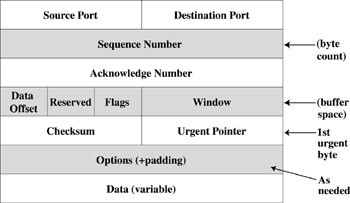
Although the IP packets carrying these TCP segments may arrive out of order, TCP can easily resequence them. The acknowledgement field provides the reliable delivery part.
TCP's header is a minimum of 20 bytes (octets). The fields in the TCP header are as follows:
Source port and destination port The source and destination port numbers are used to identify the listening agent that is using TCP to transfer data. IP uses the protocol field; TCP uses the port number. The port address, in conjunction with the IP address of the packet, is referred to as the socket. Therefore, in order for a socket to exist, one needs both the IP address and the port address. Port addresses below 1024 are assigned by (or reserved for assignment) by the IETF. When you surf the Web, your browser always uses TCP port 80. One can provide web servers on other ports (for example, port 8080), but to use that port, the sender has to specify the port number after the host name because the default is port...