Broadband Telecommunications Handbook, Second Edition

A blockbuster overview of broadband updated and expanded to reflect the latest technologies.
 TABLE OF CONTENTS
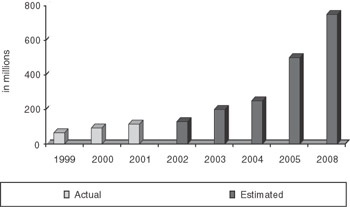
 No one can argue that the growth of the Internet has been exceptional. Depending on what report you read or what research house publishes, the numbers may differ slightly, but the overall result is the same. The Internet is explosive. The events of 2000 and 2001 have caused the growth to slow a bit, but overall we can expect to see continued growth and expansion of the Net. In October 2000, a reported 93 million hosts were attached to the Internet, which represents an increase from 65 million in the same period of 1999. In actuality, there have been over 60 million hosts attached over a three-year period. The graph shown in Figure 34-1 is a representation of the growth and projections for the Internet with some statements estimating over a billion users and 750 million hosts in 2008. Using any calculation method, this is still impressive.
Whether the Internet meets or exceeds the growth projections, one thing is certain IP networking will be the standard networking protocol for the future, and the growth will place a burden on the ability to process the data packets quickly. The more hosts and users logging onto the network, the exponential growth in routing tables and routers are needed to process the data. Because of the monstrous growth rates, the carriers and vendors alike need to find a more efficient way of dealing with the traffic deluge. Optimizing...