Catalysis in Application

While combining a unique mix of chemistry and chemical engineering, this up-to-date text provides a snapshot of hydrogenation, dehydrogenation, chiral catalysis, environmental catalysis, and catalyst deactivation.
Many negative experiences with the relation of characterisation results to functional performance have their origin in the fact that a "non-relevant" property of the catalyst has been analysed with no physical relation to the function. The typical example is the application of X-ray powder diffraction phase analysis used to correlate structure with catalytic performance. In general, there exists a relation between bulk structure and surface properties. The details of this relation are, however, difficult to unravel, as reconstructions that minimise the free energy tend to modify grossly the bulk structure in the surface-near region. In Figure 1(A) the structure determination of iron oxide is exemplified2. It should be noted that the distances between the top atomic layers deviate in both directions from the respective bulk values by a factor of 2. It is the great virtue of surface science studies of catalytic model systems to provide such data. They give evidence that the surface chemistry and so the disposition of active sites cannot be deduced from cuts through the bulk phase and thus render it difficult to correlate the information about the average solid phase with the structure of the active phase or even with that of the active sites.
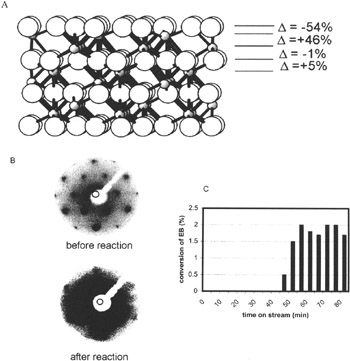

 TABLE OF CONTENTS