Chemical and Process Design Handbook

Invaluable to chemical and environmental engineers as well as process designers, this easy-to-read book shows you how to control chemical processes to yield desired effects efficiently and economically.
 TABLE OF CONTENTS
 Pure alumina (Al 2O 3) is a dry, snow-white, free-flowing crystalline powder and may be obtained in a wide range of particle sizes.
There are two main types of alumina (bauxite) ores used as the primary sources for aluminum metal and aluminum chemicals: aluminum hydroxide [Al(OH) 3] (gibbsite) and a mixed aluminum oxide hydroxide [AlO(OH)] (boehmite). Thus, bauxite is a term for a family of ores rather than a substance of one definite composition. An average composition of the ores used by industry today would be: alumina (Al 2O 3), 35 to 60%; silica (SiO 2), 1 to 15%; ferric oxide (Fe 2O 3), 5 to 40%; and titanium dioxide (TiO 2), 1 to 4%.
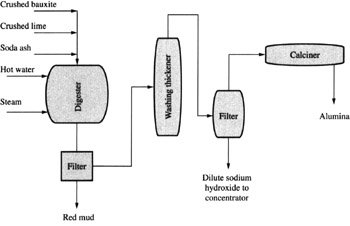
In the process to produce alumina (Fig. 1), bauxite is crushed and wet ground to 100-mesh, dissolved under pressure and heated in digesters with concentrated spent caustic soda solution from a previous cycle and sufficient lime and soda ash. Sodium aluminate is formed, and the dissolved silica is precipitated as sodium aluminum silicate. The undissolved residue (red mud) is separated from the alumina solution by filtration and washing and sent to recovery. Thickeners and Kelly or drum filters are used. The filtered solution of sodium aluminate is hydrolyzed to precipitate aluminum hydroxide by cooling. The precipitate is filtered from the liquor, washed, and heated to 980 C in a rotary kiln to calcine the aluminum hydroxide.
Several other...